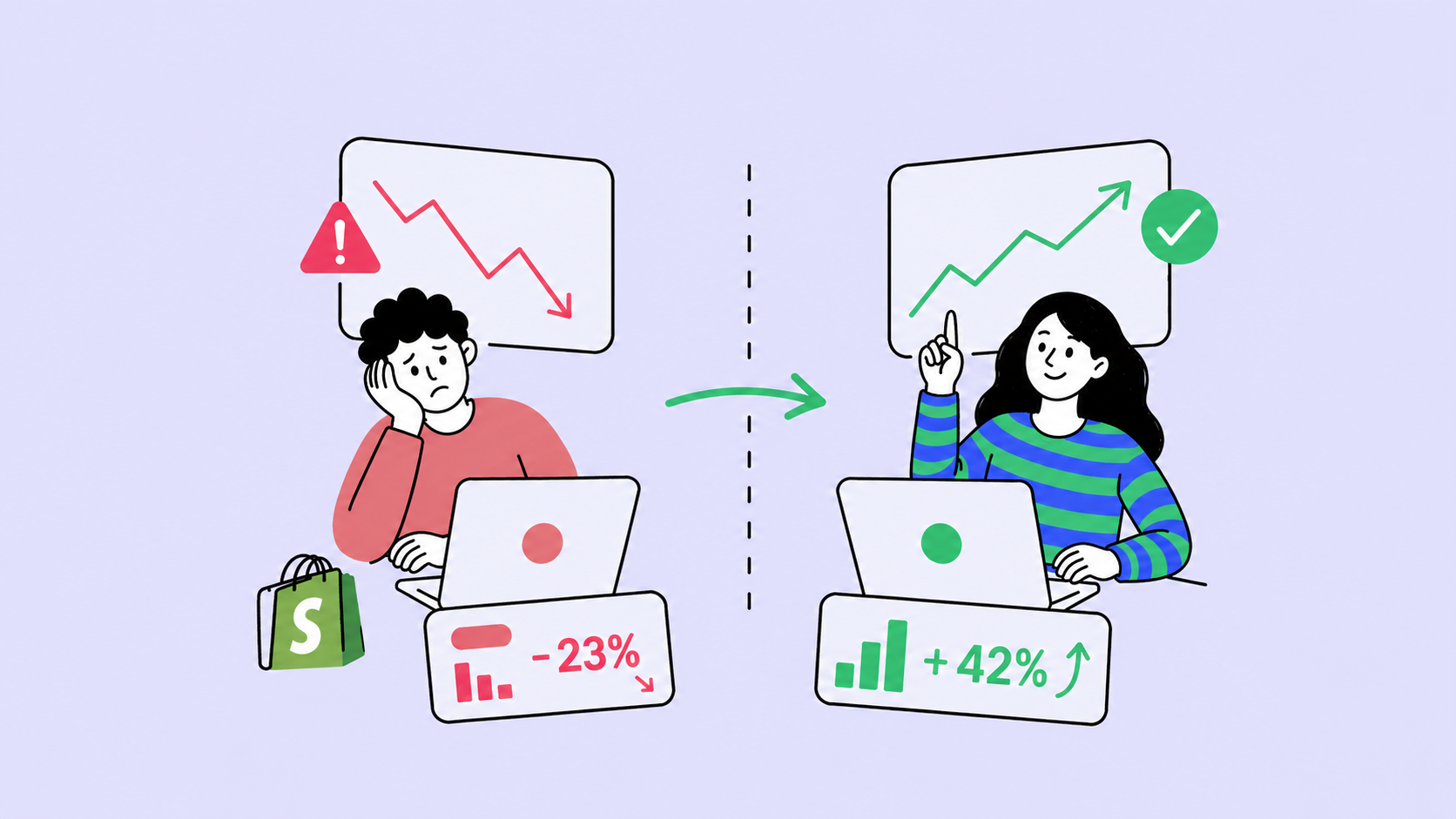
In 2026, most Shopify stores aren’t short on traffic, marketing ideas, or acquisition tools. What they lack is the ability to turn that acquisition into lasting value.
As long as CAC remains the main compass, growth can look healthy… while quietly weakening profitability month after month.
The Old World: When CAC Was (Almost) Enough
For years, the logic was straightforward:
- Buy traffic through Meta, Google, and TikTok.
- Improve onsite conversion rates.
In a world where media costs were lower, competition was less intense, and customer expectations were simpler, this model could work and sometimes work very well.
The problem is that the landscape has changed :
- Customer acquisition costs have risen,
- Margins have tightened due to inflation, logistics, and product costs,
- Customer journeys have become more fragmented,
- Customer loyalty can no longer be taken for granted.
In this new environment, managing growth solely through CAC is like watching the beginning of a movie and assuming you already know how it ends.
What CAC Will Never Tell You
CAC answers only one question : « How much does it cost me to acquire a new customer ? ».
It tells you nothing about how much that customer will actually generate over time.
In practice, two Shopify stores can have the exact same CAC:
- Store A : €30 CAC, customer never purchases again,
- Store B : €30 CAC, customer places three orders within a year.
On paper, the CAC is identical.
From a business perspective, however, the second store has a dramatically stronger model.
When you optimize solely for CAC, you risk :
- Favoring channels that generate volume but attract low-engagement customers,
- Overinvesting in audiences that purchase once and never return,
- Underestimating the value of smaller but highly profitable customer segments.
LTV as Your New Compass
Lifetime Value (LTV) puts the focus back where it belongs :
« How much revenue will this customer actually generate over a given period, and how quickly ? ».
This shift requires several important mindset changes :
- Channels are no longer evaluated on CAC alone, but on their LTV-to-CAC ratio,
- The first order is no longer the only metric that matters; repeat purchases, long-term average order value, upsells, and cross-sells become equally important,
- Customer acquisition is no longer viewed as a cost, but as an investment that must generate a return.
For a Shopify store, this means :
- A channel with a slightly higher CAC but significantly higher LTV is often the better investment,
- A channel that performs exceptionally well in terms of volume but delivers poor LTV can actually destroy value.
Aligning Acquisition and CRM: The End of Silos
Moving toward an LTV-driven strategy requires breaking a common habit :
- Acquisition teams are evaluated on cost and volume,
- CRM teams are evaluated on opens, clicks, and a handful of sales.
With an LTV mindset :
- Acquisition and CRM share the same objective: creating long-term value, not just generating a first order.
- The first purchase becomes an entry point that must be optimized through the product, offer, and positioning to maximize repeat purchase potential.
- CRM decisions (flows, triggers, segmentation) become directly connected to acquisition decisions (channels, creatives, and landing pages).
A Practical Example :
- Suppose you discover that customers acquired through a specific Meta campaign and messaging angle generate significantly higher LTV, In that case, you are no longer optimizing solely for CPA, You are optimizing the campaign’s ability to attract those high-value customers.
The Metrics That Truly Matter
Putting LTV at the center does not mean building overly complex models.
It starts with tracking a few simple but highly strategic indicators :
- 3-month LTV by channel / campaign.
- 12-month LTV by acquisition channel / first purchased product.
- Average time to break even (how long it takes for cumulative net margin to exceed CAC).
- CRM’s contribution to cumulative value (post-acquisition sales versus “organic” sales).
These metrics completely change the conversation within the team :
- Instead of asking « How many customers did this campaign generate ? »,
- You start asking « What type of customers did it acquire, and how much value did they create ? ».
How to Move from CAC to LTV on Shopify
Pour une boutique Shopify, un plan simple peut ressembler à :
- Map Customer Value by Channel
- Export customers by acquisition channel,
- Measure cumulative customer value over 3–6 months (excluding extreme promotional periods),
- Identify the channels / campaigns that outperform in value not just volume.
- Connect the First Purchase to Future Value
- Compare the first purchased product with customer value after 3 or 6 months,
- Identify your strongest “entry products” (the products that attract the most valuable customers over time),
- Adapt your campaigns to promote these high-value entry products.
- Adjust CRM Strategy Accordingly
- Do not treat a high-potential customer acquired at a high cost the same way as a one-time discount buyer,
- Adapt campaigns to promote these entry points.
- Build a Simple LTV Reporting Framework
- Create a monthly view of LTV by channel / campaign / first purchased product,
- Establish recurring acquisition + CRM based on these insights.
Make Decisions with a Better Compass
Managing by LTV does not guarantee growth.
But managing without LTV makes growth inherently fragile. : You can « scale » a model that destroys value without even realizing it.
The real question is no longer : « How much does a customer cost me ? »,
Instead, it becomes : « What am I willing to invest today to acquire customers who will create meaningful value tomorrow ? ».